
3DEXPERIENCE and ENOVIA customisation
We review ENOVIA extensions and CATIA business rules against the release and deployment they run on. For each change we record the event, object type and downstream behaviour it affects, then define a repeatable regression test. Where standard configuration does the job, we'll say so.
Problems this covers
- Attributes your process needs aren't on parts or documents
- A trigger or JPO blocks valid promotes, or lets bad data through
- Part numbers are typed by hand and duplicates appear
- Users click through several screens to find simple information
- Repetitive reporting and housekeeping done by hand
- Old customisations nobody understands are blocking an upgrade
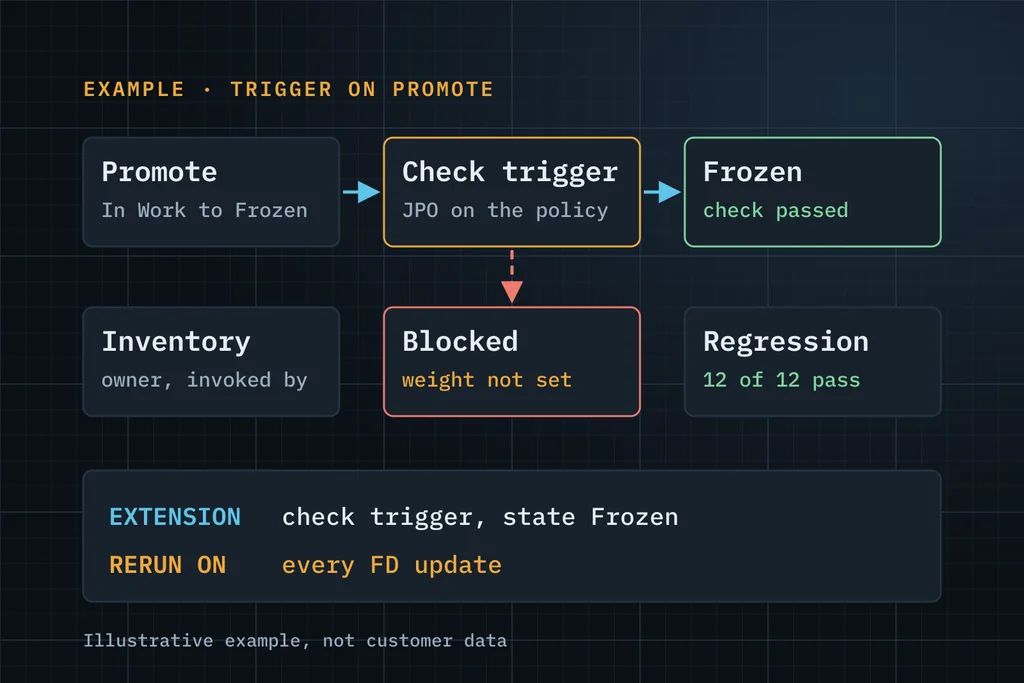
From extension point to a repeatable test
Configuration first
Check whether the installed apps and current release can meet the need without code.
Design
Record the extension point, invocation conditions, configuration dependencies and deployment procedure before building.
Build and test
Build in a test environment. Test a valid action, a rejected action and a repeated request, before and after the target update.
Document
An inventory entry, source location and test scripts, so the next upgrade starts from facts.
Areas we work on
- ENOVIA policy triggers and JPOs on customer-managed installations, where permitted
- Schema, attribute and trigger configuration through the documented mechanism for your apps and release (read-only MQL inspection where permitted)
- EKL business logic at supported application extension points
- Attribute and numbering rules, tested for missing values and duplicates
- 3DDashboard widgets and integrations using documented web services
- Scheduled jobs and reports that replace manual housekeeping
Three ways to start
Start with free support
Up to 5 hours to understand the issue and tell you what to check or do next. No obligation.
Request free supportEssentials assessment Paid
A written problem statement, recommended next steps, a proposed scope and an effort estimate. You approve the fee before it starts.
Ask about an assessmentDiscuss a scoped project
Upgrade, migration, integration, customisation or configuration with a defined goal. We reply with questions, then a proposal.
Discuss a projectWhat to include in your first message
- What the change should do, in business terms
- Where it applies: type, policy, state or user action
- Existing customisations involved (JPO, trigger, EKL, widget)
- Cloud or customer-managed, release and FD
- When you need it and who will test it
A few lines are enough. Please leave out passwords, confidential CAD files and customer data.
Common questions
Will customisations break at the next upgrade?
They can. We use supported extension points, keep custom code out of delivered files, and leave tests you can rerun on the target release. We don't promise a change survives an unknown future update.
Can you fix customisations someone else wrote?
Yes. We start with an inventory: what exists, what triggers it and what depends on it.
Cloud or on-premise?
Both, but the available extension mechanisms differ. JPOs, triggers and server-side MQL apply to customer-managed installations. On the cloud we confirm what your release and roles allow first.
Describe the failed operation, release and deployment.
Describe it in a few lines. If it's a good fit, we'll use up to 5 hours of free support to understand it and tell you plainly what to check or do next.